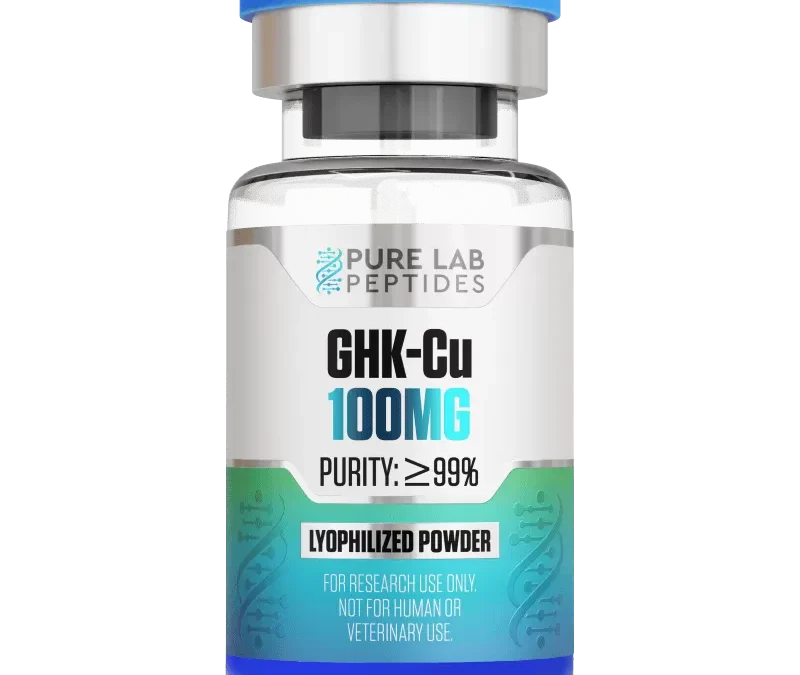
Buy GHK-Cu 100mg Online
What GHK-Cu 100mg is:
GHK-Cu is a copper peptide made of glycyl-L-histidyl-L-lysine bound to copper. The “100mg” refers to the total peptide content in the vial, usually supplied as lyophilized powder for reconstitution. It’s a naturally occurring peptide found in human plasma, saliva, and urine, but levels drop with age. Labs synthesize it to study tissue repair and skin health.
How GHK-Cu 100mg works
GHK-Cu acts like a “repair signal” in the body. It binds copper and delivers it to cells where it’s needed for enzymes like lysyl oxidase, which helps build collagen and elastin. It also modulates gene expression – upregulating genes involved in wound healing, antioxidant defense, and blood vessel growth, while downregulating inflammatory genes. That’s why it’s studied for skin, hair, and tissue repair
Common uses people research GHK-Cu 100mg for
The biggest focus is skin. GHK-Cu is known for supporting collagen synthesis, improving skin elasticity, reducing fine lines, and speeding up wound healing. It’s also studied for hair health due to its effect on follicle activity, and for tissue repair after injury. Because it’s a peptide, it’s often labeled “for research use only” when sold online in 100mg vials.
Form & reconstitution of GHK-Cu 100 mg
A 100mg vial comes as a freeze-dried powder. Researchers reconstitute it with sterile bacteriostatic water to a desired concentration, like 10mg/mL. From there, dosing depends entirely on the research protocol. Once reconstituted, it needs refrigeration and should be protected from light since peptides degrade with heat and UV.
Quality markers to check
If you’re sourcing GHK-Cu 100mg, look for third-party COAs showing purity >98% and peptide content verification. Reputable suppliers ship cold and provide batch/lot numbers. The powder should be light blue due to the copper, not brown or clumped. Proper packaging and storage instructions are key because copper peptides are sensitive.
Bottom line
*GHK-Cu 100mg* is one of the most studied copper peptides for its role in repair and regeneration. It’s not a drug and has no FDA approval for medical use – it’s a research peptide. Anyone working with it should follow proper lab safety, reconstitution, and storage protocols, and understand it’s for research purposes only. The science behind it is strong, but human application requires medical guidance.